 ultimate-guide
Signs of a Dead Battery: 8 Warning Signs
Table of Contents
- 8 Signs of a Dead Battery You Should Never Ignore
- Alternator vs Battery Symptoms: How to Tell the Difference
- DIY Diagnostic Tools to Test a Dead Battery at Home
- How Climate and Modern Electronics Accelerate Battery Failure
- How to Jumpstart a Car Safely: Step-by-Step
- Car Battery Replacement Cost: What to Expect
- When to Call for 24/7 Roadside Assistance
- Frequently Asked Questions
Last Updated: September 1, 2026
8 Signs of a Dead Battery You Should Never Ignore
Your car battery quietly degrades over months and years until one morning it refuses to start your engine. At RCRA, we respond to dead battery calls around the clock, and the same warning signs show up repeatedly before drivers get stranded. Recognizing early indicators saves you from a roadside emergency and a towing bill.
Slow Engine Crank or No Crank at All
When you turn the key and the engine turns over sluggishly or makes a grinding sound before catching, your battery's cranking amps are too low. If the engine doesn't turn over at all, the battery voltage has likely dropped below the ignition system's threshold. A healthy 12-volt lead-acid battery reads around 12.6 volts at rest. Anything below 12 volts is a warning; below 11.8 volts, most vehicles won't crank at all.
Clicking Sound When You Turn the Key
A rapid clicking sound when you turn the key is a classic dead battery signal. The starter solenoid is engaging repeatedly because the battery can't deliver enough current to spin the starter motor. A bad starter typically produces a single heavy clunk; rapid clicking almost always means insufficient battery voltage.
Dim Headlights and Interior Lights
Dim headlights and flickering interior lights indicate your battery's capacity is dropping. When battery health deteriorates, there isn't enough stored energy to power everything at normal brightness. If headlights dim noticeably during cranking and then brighten, the battery is struggling to handle the electrical load of ignition.
Dashboard Battery Warning Light
The battery warning light is triggered when the charging system detects a voltage drop outside normal range. This can indicate a battery problem, alternator issue, loose belt, or corroded terminals. According to AAA's vehicle reliability research, battery-related failures are among the most common reasons drivers call for roadside assistance. Get the charging system tested before the battery discharges completely.
Swollen or Bloated Battery Case
A swollen or bloated battery case is a serious warning sign. Battery case swelling happens when excessive heat causes the electrolyte to expand, warping the plastic casing. This is common in hot climates and poses a risk of leaking battery acid. Do not attempt to jump-start a battery with a visibly swollen case. Replace it immediately.
Corrosion on Battery Terminals
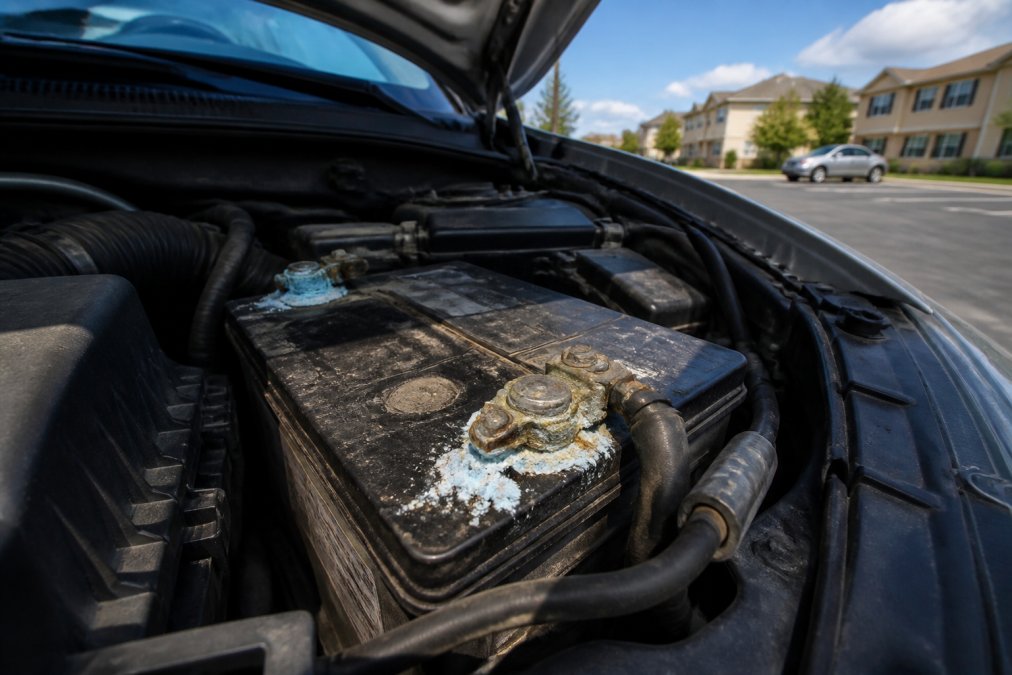
Terminal corrosion, white, blue, or greenish powdery buildup around the battery posts, creates resistance in the circuit between the battery and electrical system. Enough corrosion can prevent a fully charged battery from delivering power to the starter motor. Light corrosion can be cleaned with a wire brush and baking soda solution. Heavy corrosion means the connections need replacement.
Battery Age Over Three to Five Years
Most lead-acid batteries have a life cycle of three to five years under normal conditions. After that point, sulfation reduces the battery's ability to hold a charge. As noted by the Car Care Council's battery maintenance guidance, checking battery age at the three-year mark and testing capacity annually after that is sound preventative maintenance. Check the date code printed on the label if you don't know your battery's age.
Frequent Jump-Starts Required
Needing a jump-start more than once in a short period is not coincidence. A battery that accepts a charge but fails again within days has a deep discharge problem. One jump-start is an incident; two in a week is a pattern that demands diagnosis.
Alternator vs Battery Symptoms: How to Tell the Difference
Distinguishing alternator from battery symptoms is where most drivers get confused. Here's the clearest way to separate the two.
The battery is the primary suspect when:
- The car won't start after sitting overnight
- The car starts fine after a jump-start and runs normally
- The battery is more than four years old
- You see corrosion on the terminals
The alternator is the primary suspect when:
- The car stalls shortly after a jump-start
- Lights dim progressively while the engine is running
- The battery warning light comes on during driving, not just at startup
- Electrical accessories behave erratically at highway speed
The key distinction: an alternator charges the battery while the engine runs. If your car starts after a jump but dies within 20-30 minutes of driving, the alternator is not recharging the battery.
| Symptom | Battery Issue | Alternator Issue |
|---|---|---|
| Won't start after overnight sit | Yes | Unlikely |
| Stalls after jump-start | No | Yes |
| Dim lights while engine runs | Sometimes | Yes |
| Battery warning light at idle | Possible | Common |
| Lights flicker at highway speed | Rarely | Yes |
| Resolves after jump-start | Temporarily | No |
A multimeter test settles the question quickly. With the engine off, a healthy battery reads 12.4-12.7 volts. With the engine running, the charging system should push that to 13.7-14.7 volts. A reading below 13.5 volts with the engine running points to alternator trouble.
DIY Diagnostic Tools to Test a Dead Battery at Home
A basic multimeter is the most useful tool any driver can own for battery diagnosis and costs less than a fast-food lunch.
How to test your battery with a multimeter:
- Set the multimeter to DC voltage (20V range)
- Connect the red probe to the positive terminal, black to the negative
- Read the resting voltage with the engine off
- Start the engine and read the voltage again
- Rev the engine slightly and check whether voltage rises
A resting voltage below 12.4 volts suggests the battery is partially discharged or failing. A voltage that drops below 10 volts during cranking indicates the battery cannot deliver adequate cold cranking amps for your engine. Many auto parts stores will perform a battery load test for free.
How Climate and Modern Electronics Accelerate Battery Failure
Heat is harder on lead-acid batteries than cold. High temperatures accelerate chemical reactions inside the battery, speeding up water loss and sulfation. Batteries in hot climates often fail in two to three years rather than four to five. Cold weather reduces available cranking amps; a battery at 80% capacity in summer may only deliver 50% at freezing temperatures, which is why dead battery calls spike every winter.
Modern vehicles compound the problem. Today's cars carry significantly more electronic load: lane-keep assist, automatic start-stop systems, heated seats, and sophisticated infotainment systems all draw from the battery. Start-stop systems subject batteries to far more charge-discharge cycles than conventional vehicles and require AGM (Absorbent Glass Mat) batteries specifically engineered for deep cycling. Replacing an AGM battery with standard lead-acid in a start-stop vehicle will shorten battery life significantly.
CLICK HERE TO CALL US NOW!!! →
The 12-volt auxiliary battery in a hybrid or electric vehicle is separate from the high-voltage traction battery and powers onboard electronics. According to the U.S. Department of Energy's alternative fuels resource, hybrid and EV owners should follow the same auxiliary battery maintenance schedule as conventional vehicle owners.
How to Jumpstart a Car Safely: Step-by-Step
Jump-starting a car is straightforward when done in the correct order. The sequence matters because connecting cables incorrectly can damage sensitive vehicle electronics.
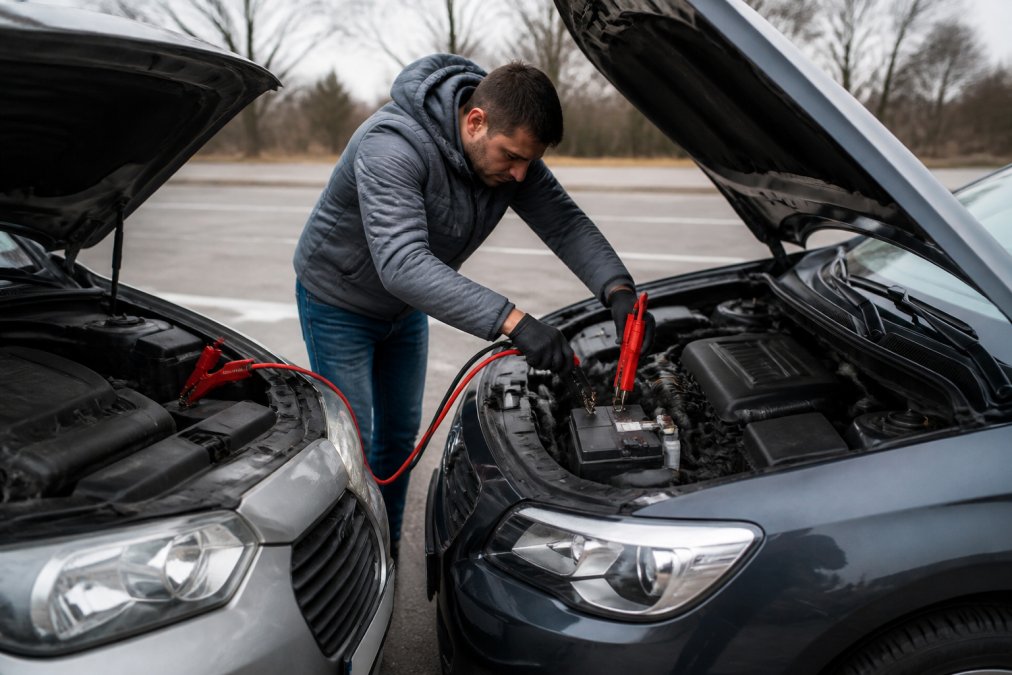
What you need: jumper cables rated for your vehicle's engine size and a working donor vehicle with a charged battery.
Step-by-step:
- Park the donor vehicle close enough that cables reach both batteries, but ensure the vehicles are not touching
- Turn off both vehicles
- Connect the red (positive) cable to the positive terminal of the dead battery
- Connect the other red end to the positive terminal of the donor battery
- Connect the black (negative) cable to the negative terminal of the donor battery
- Connect the other black end to an unpainted metal surface on the dead vehicle's engine block. Do not connect to the dead battery's negative terminal directly
- Start the donor vehicle and let it run for two to three minutes
- Attempt to start the dead vehicle
- Once running, disconnect cables in reverse order: black from engine block, black from donor, red from donor, red from previously dead battery
- Drive the revived vehicle for at least 20-30 minutes to allow the alternator to recharge the battery
If the vehicle won't start after two jump-start attempts, stop. Repeated cranking drains the donor battery and may indicate the problem is not the battery alone.
Car Battery Replacement Cost: What to Expect
Car battery replacement cost varies depending on your vehicle's battery type, group size, and whether you choose professional installation. Pricing also differs between standard lead-acid batteries and AGM batteries, which cost more but are required for start-stop vehicles and many newer models. Check with a local auto parts retailer or your dealership's service department. Many auto parts stores will install a battery purchased from them at no additional charge. The Battery Council International's fitment guide is a reliable reference for matching the correct battery to your vehicle's specifications.
The real cost of waiting too long to replace a failing battery is often higher than the battery itself. A battery that fails while driving can damage the alternator or vehicle electronics. Replacing a battery proactively costs less than replacing a battery and an alternator.
When to Call for 24/7 Roadside Assistance
Call for roadside assistance when:
- You're stranded in an unsafe location (highway shoulder, dark parking lot, extreme weather)
- You don't have jumper cables or a donor vehicle nearby
- The battery has a visibly swollen case or smells of sulfur
- The vehicle won't start after two jump-start attempts
- You've needed a jump-start more than once this week
RCRA provides 24/7 roadside assistance with live agent support, meaning a real person answers your call at 2 AM, not an automated system. Flat rate service call pricing means no surprise fees after the fact. Service covers the Hutchinson and South Hutchinson areas with local technicians.
If you're not sure whether your situation qualifies, call anyway. That's what we're here for.
Signs of a dead battery are almost always visible before the battery fails completely. The challenge is knowing what to look for and acting on it before you're stranded.
Dead batteries don't wait for a convenient moment. RCRA's 24/7 roadside assistance is built for exactly the situations that catch you off guard: the dead battery at midnight, the failed start before an early shift, the clicking ignition in a parking garage. With live agent support, flat rate pricing, and local coverage across Hutchinson and South Hutchinson, help is one call away. CLICK HERE TO CALL US NOW.
Frequently Asked Questions
How do you know if it's just a dead battery or something else?
The clearest sign of a dead battery is a slow or absent engine crank when you turn the key, especially when headlights and interior lights are also dim or off. If the engine cranks normally but won't fire, the battery is likely fine and the issue is elsewhere, such as the fuel system or ignition. A multimeter reading below 12.4 volts with the engine off confirms a weak or dead battery. If lights flicker while driving, suspect the alternator instead.
How does a car act when the battery is dead?
A car with a dead battery typically produces a slow, labored crank or a rapid clicking sound when you turn the ignition. Headlights may appear dim or fail to turn on at all. Power windows, interior lights, and infotainment systems may respond sluggishly or not respond at all. In some cases, the car shows no signs of life whatsoever. A dashboard battery warning light may also illuminate before the battery fully dies, giving you an early heads-up.
How do you tell if it's the alternator or the battery causing the problem?
Jump-start the car. If it starts and then dies again within minutes, the alternator is likely not charging the battery while driving. If the car stays running after a jump-start but won't start again after you turn it off, the battery is the culprit. You can also use a multimeter: with the engine running, a healthy charging system reads between 13.7 and 14.7 volts at the battery terminals. A reading below 13 volts points to an alternator problem rather than a dead battery.
Can you jumpstart a completely dead battery?
Yes, in most cases you can jumpstart a completely dead battery if the battery cells are not physically damaged or shorted internally. Connect jumper cables correctly, let the donor vehicle run for a few minutes to push some charge into the dead battery, then attempt to start. If the battery is severely discharged from deep discharge or sulfation, it may not accept enough charge to start the engine. At that point, a replacement is the only reliable fix. Call a roadside assistance service if you're unsure.
What are the most common causes of a car battery dying?
Leaving lights or accessories on overnight is the most frequent cause of a dead battery. Parasitic drain from a faulty relay, alarm system, or aftermarket electronics can also drain a battery slowly over days. Extreme cold reduces a battery's cold cranking amps, making it struggle to start. Heat accelerates electrolyte evaporation and plate corrosion. An aging battery past its four- to five-year lifespan loses the capacity to hold a full charge, and a failing alternator stops replenishing the charge during driving.
How long does a typical car battery last?
Most lead-acid car batteries last three to five years under normal driving conditions. Batteries in hot climates often fail closer to the three-year mark because heat degrades the electrolyte and internal plates faster. Batteries in cold climates may last longer but are more likely to fail suddenly on a cold morning when cranking amps are most needed. Regular testing after the three-year mark, using a multimeter or a load tester at an auto parts store, helps you catch a weak battery before it leaves you stranded.