 ultimate-guide
Roadside Assistance Hidden Fees: How to Avoid Them
Table of Contents
- Why Roadside Assistance Bills Surprise You
- Common Towing Service Surcharges That Inflate Your Bill
- Questions to Ask Before Calling a Tow Truck
- Roadside Assistance Membership vs Pay-Per-Use: Which Costs Less?
- How to Verify an Honest Towing Provider
- Red Flags of Predatory Towing Practices
- Your Action Plan for Transparent Roadside Help
- Frequently Asked Questions
Last Updated: September 5, 2026
Why Roadside Assistance Bills Surprise You
A stranded driver usually calls for help in a panic, and that urgency is exactly what many towing companies count on. The quoted price over the phone rarely matches the final bill because hidden fees get added after the hook-up, when you have no leverage to negotiate.
At RCRA, the core problem is that most consumers compare only the advertised service call price, ignoring the line items that determine the total: dispatch fees, mileage allowances, and after-hours surcharges. This guide shows you how to spot those charges before you commit, what questions to ask, and how to verify an honest provider.
Common Towing Service Surcharges That Inflate Your Bill
Towing invoices are rarely a single flat rate. Most bills combine a base service call with variable charges that depend on distance, time of day, and equipment used. The difference between estimate and final total often comes down to three categories of fees added incrementally.
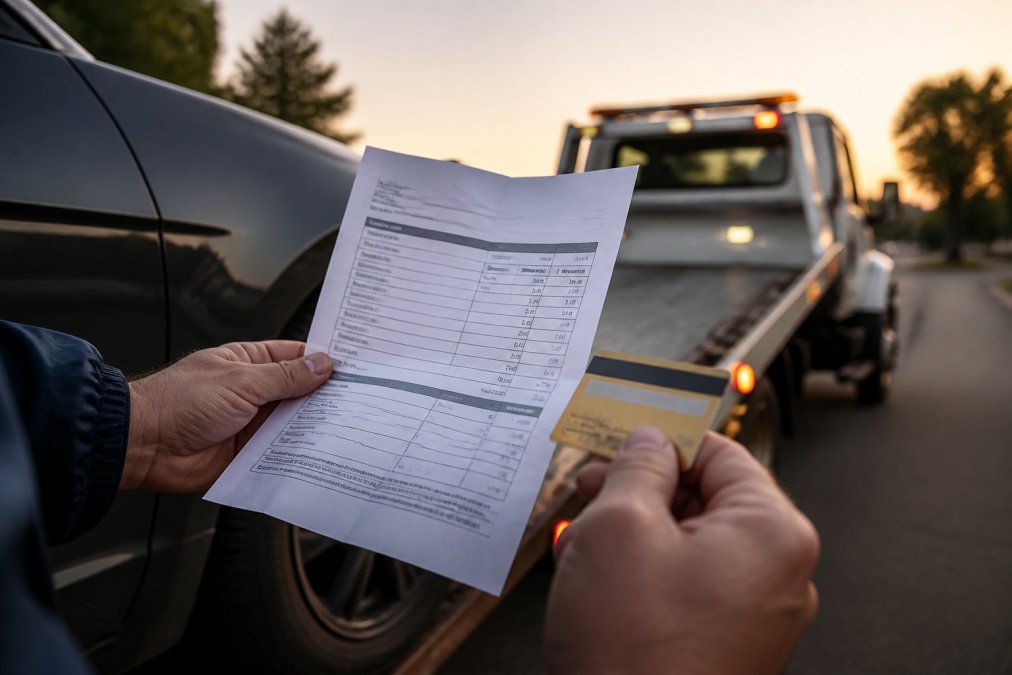
Knowing the category name is not enough. The real defense lies in the specific wording of the service agreement or verbal estimate, so this guide tells you exactly which clauses to scrutinize.
Dispatch Fees and Hook-Up Charges
A dispatch fee is a charge for the call center that routes the truck to your location. Some companies bundle it into the service call; others list it separately.
Contract clause to check: Look for "dispatch and administrative fee." Some providers split this into two line items, double-charging for the same work. If the quoted price includes dispatch, confirm the written estimate states "dispatch included" rather than merely listing a dollar amount.
The hook-up charge covers labor and equipment to attach your vehicle to the truck. It applies even if the truck moves your car only a few feet, is typically non-negotiable once the driver arrives, and usually does not include the towing distance.
Contract clause to check: The critical wording is "hook-up fee is non-refundable upon arrival," meaning you owe it even if you change your mind. Ask whether the fee is waived if the driver cannot complete the tow due to a mechanical issue with the truck.
Mileage Allowances and After-Hours Surcharges
Most towing services quote a price with a limited mileage allowance, often five to ten miles. Every mile beyond that triggers a per-mile rate that can escalate quickly on a highway far from a repair shop.
Contract clause to check: "Loaded miles" versus "total miles" changes your bill significantly. Some providers calculate mileage from dispatch to the scene and then to the destination, so a five-mile tow can become fifteen miles if the truck came from across town. Confirm the per-mile rate applies only to the distance your vehicle is on the truck.
After-hours surcharges apply to calls outside normal business hours. Nighttime, weekends, and holidays routinely carry higher rates, and some providers double the base fee after midnight. Confirm whether the quoted price includes this rate or if it will be added on top.
Contract clause to check: Look for the definition of "business hours." Some define it as 8:00 AM to 5:00 PM Monday through Friday, making any weekend call after-hours. The difference between a 20% and 50% surcharge can be hundreds of dollars on a long tow.
The "Service Call Minimum" Trap
A less obvious fee appears in the fine print as a service call minimum, stating that even if the work takes ten minutes, you pay for a minimum of one full hour.
Contract clause to check: Ask whether the quoted price is a flat rate or an hourly rate with a minimum. Flat-rate pricing for common services like jumpstarts and lockouts is more predictable; hourly rates with minimums create uncertainty that works in the provider's favor.
The "Environmental" and "Equipment" Add-Ons
Some invoices include line items labeled environmental fee or equipment recovery charge, discretionary add-ons appended to the final bill, counting on the customer being too exhausted to question them. The FTC treats undisclosed mandatory fees as potentially misleading, but the burden of disputing them falls on you after service.
The Documentation Defense
Every fee dispute comes down to what you can prove. When the truck arrives, photograph the odometer before loading, the hook-up point, and any visible undercarriage damage. Save the text or screenshot of the written estimate if the dispatcher sent one.
A common pattern is the driver claiming the vehicle required special equipment or extra distance not visible during the call. Your photos and written estimate create a contemporaneous record that contradicts those claims, and presenting it at payment usually resolves the dispute immediately.
Questions to Ask Before Calling a Tow Truck
The single most effective way to avoid hidden fees is to ask direct questions during the initial call. A legitimate dispatcher will answer clearly; one that hedges or rushes you off the phone is signaling trouble.
Ask these five questions before agreeing to service:
- What is your total dispatch fee, and is it included in your quoted service call price?
- How many miles does your base rate cover, and what is the per-mile charge beyond that allowance?
- Is there an after-hours surcharge applied to your current time of day, and how much is it?
- Do you charge a separate hook-up fee, and is it refundable if the vehicle cannot be towed?
- Can you provide an itemized invoice estimate in writing before the truck arrives?
Roadside Assistance Membership vs Pay-Per-Use: Which Costs Less?
The membership vs pay-per-use decision depends on how often you expect to need help. An annual membership spreads cost across a year and includes a defined set of service calls with stated limits. Pay-per-use means paying the full rate only when you call, but you are exposed to every surcharge the provider adds.
For drivers who call more than once a year, membership plans usually deliver better value because the service cap is fixed. For drivers who have never needed a tow, pay-per-use avoids paying for unused coverage.
| Option | Best For | Key Advantage | Main Risk |
|---|---|---|---|
| Annual Membership | Frequent drivers, older vehicles | Fixed coverage limits, predictable cost | Paying for unused service |
| Pay-Per-Use | Rare breakdowns, new vehicles | No upfront cost | Exposure to variable surcharges |
| Insurance Add-On | Bundled coverage seekers | Low monthly addition to policy | Policy exclusions, reimbursement limits |
The critical variable is contract transparency. Membership agreements list exclusions and caps in writing; pay-per-use pricing depends on the dispatcher you reach. Review membership terms for mileage limits and service caps before enrolling.
How to Verify an Honest Towing Provider
Verifying a provider before you need them is the most reliable way to avoid predatory billing. Check whether the company has a physical address and a local phone number that reaches a live person, not just a dispatch call center.
Ask for their service agreement in advance. An honest provider will share their full rate sheet, including hook-up charges, mileage rates, and after-hours policies. A provider that hesitates to put pricing in writing is a red flag. You can also check consumer protection resources like the Federal Trade Commission guidance on auto repair and towing scams to understand common deceptive practices and your rights when disputing charges.
Ask neighbors and local mechanics in Hutchinson and South Hutchinson which towing services they trust. A provider with deep local roots depends on repeat business and referrals, creating a strong incentive for honest billing.
Red Flags of Predatory Towing Practices
Predatory towing is a documented problem, and the American Automobile Association's consumer protection resources outline several warning signs that drivers should recognize. The most common red flag is a refusal to provide a written estimate before dispatching a truck.
Watch for these specific behaviors:
- Dispatcher cannot state the per-mile rate or mileage allowance clearly
- No physical address, or the address leads to a residential property
- Demands payment before the vehicle is loaded onto the truck
- Truck arrives without visible company name and license plate numbers
- Driver pressures you to sign a waiver releasing them from liability
Your Action Plan for Transparent Roadside Help
Avoiding inflated charges requires preparation before the emergency, not negotiation during it. Save the number of a verified local provider in your contacts now and keep a copy of their rate sheet in your glove compartment.
When you call, demand an itemized estimate in writing. Confirm the dispatch fee, mileage allowance, per-mile rate beyond that allowance, and any after-hours surcharge. If the provider cannot answer, call someone else.
The 60-Second Pre-Dispatch Checklist
Before you say "yes" to any provider, run through this checklist verbally with the dispatcher. If they cannot answer all five items in under a minute, call another company.
- Total dispatch fee, Confirm the exact dollar amount and whether it is included in the quoted service call price.
- Mileage allowance, Confirm the included miles and the exact per-mile rate beyond that allowance.
- After-hours surcharge, Confirm whether the current time of day triggers an additional fee and the exact percentage or dollar amount.
- Hook-up fee, Confirm whether it is separate from the service call and whether it is refundable if the tow cannot be completed.
- Payment method, Confirm whether the driver accepts credit cards or demands cash. Cash-only demands are a common predatory practice.
The Post-Service Dispute Script
If the final bill exceeds the written estimate, use this script when you speak to the driver or the billing office:
"I agreed to a written estimate of [amount] that included [list the specific fees discussed]. This invoice includes [list the unauthorized charges]. I am prepared to pay the agreed amount now. Please remove the unauthorized charges, or I will dispute the full amount with my credit card company and file a complaint with my state's attorney general."
This script works because it acknowledges your willingness to pay the agreed amount, identifies the unauthorized charges, and names the consequences of refusing to correct the bill. Most disputes resolve here because a chargeback and state complaint cost the provider more than the disputed fee.
The Digital Documentation Protocol
Your phone is your best evidence tool. Follow this protocol at the scene:
- Before the truck arrives: Photograph your vehicle's location, the surrounding area, and the odometer reading.
- When the driver arrives: Photograph the truck's license plate, the company name on the door, and the driver's face.
- Before the hook-up: Photograph the undercarriage area where the tow hooks will attach, to document any pre-existing damage.
- After the tow: Photograph the vehicle at the destination, including the odometer reading and any new damage.
- Save the written estimate: Screenshot the text or email with the estimate before the truck arrives.
These photos create a timestamped record that contradicts claims of pre-existing damage or extra distance, giving you evidence to dispute an inflated bill without relying on memory.
When to Escalate a Dispute
If the provider refuses to correct the bill, escalate through three paths: initiate a chargeback with your credit card company citing the written estimate; file a complaint with your state's attorney general or the agency regulating towing companies; and file a complaint with the Better Business Bureau, which can pressure the provider to respond.
The One-Time Investment That Pays Off
Consider a one-time thirty-minute investment to call your state's public utilities commission or department of insurance to ask whether towing companies must provide written estimates before service. Some states have rate disclosure laws that give you additional leverage in a dispute.
Frequently Asked Questions
What are the most common hidden fees in roadside assistance?
Common fees include dispatch fees, hook-up charges, and after-hours surcharges. Many providers also charge per mile beyond a small allowance, plus separate fees for services like a battery jumpstart or tire change. Administrative fees can appear on the final invoice without prior notice. Asking for a full price breakdown before service begins is the best way to avoid these surprise costs.
Is it worth paying for a roadside assistance membership?
An annual membership often makes sense if you use roadside help more than once every couple of years. Membership benefits typically include a set towing radius and lower service call pricing. Pay-per-use can be cheaper for drivers who never call for help. Compare the annual membership cost against the potential out-of-pocket expenses of a single tow to decide which fits your situation.
Do roadside assistance providers charge extra for after-hours service?
Yes, many providers apply an after-hours surcharge for calls placed at night, on weekends, or on holidays. This surcharge is often a flat fee added to the base service call price. Always ask about after-hours surcharges before you agree to service, especially if you are calling at 2 AM. Getting this detail in writing prevents an inflated final bill.
How can I verify a towing company's pricing before they arrive?
Call the provider and request a complete price quote over the phone. Ask for the base service fee, the cost per mile, and any surcharges that might apply. A reputable company will provide an itemized invoice and explain its service agreement terms. If a dispatcher refuses to give a clear estimate, consider that a red flag and call another provider.
What is the difference between a dispatch fee and a hook-up charge?
A dispatch fee covers the cost of sending a technician to your location. A hook-up charge applies when the tow truck attaches your vehicle for transport. Some providers bundle these into one service call price, while others bill them separately. Knowing which fees apply helps you compare quotes from different companies and avoid paying twice for the same part of the service.
Getting stranded is stressful enough without wondering whether the tow bill will empty your wallet. The fix is to treat roadside assistance like any other purchase: verify the provider, demand written pricing, and know which fees are legitimate before you agree to service. RCRA delivers immediate roadside assistance with upfront pricing, so you are never left guessing about the final cost. CLICK HERE TO CALL US NOW and get the transparent help you need.